
How FMOL Health | Our Lady of the Lake Doubled Early Detection and Transformed Lung Cancer Outcomes
In Southern Louisiana, less than a quarter of lung cancers are diagnosed early. See how Our Lady of the Lake (OLOL) partnered with Eon on longitudinal care management to drive early-stage diagnoses and necessary downstream exams and procedures.
- 260 Cancers diagnosed
- 70% Stage I or II diagnosis rate at OLOL
- 207% Growth in Ion bronchoscopies

Scaling early detection wasn’t possible with existing processes
Recognizing the clinical urgency of early diagnosis, OLOL set out to scale their lung program. Like most health systems across the country, they initially relied on manual workflows. As imaging volumes grew, the team found these legacy tools couldn't support their goals.
Challenges:
- Outgrowing manual tracking methods
- Absorbing rising incidental findings volume
- Maintaining longitudinal visibility
- Ensuring consistency at a higher operational scale

A centralized, AI-driven approach to lung program management
OLOL implemented Eon to standardize identification, tracking, and management of patients for lung cancer screening and incidentals – expanding the initiative to seven sites. Clinical intelligence is delivered automatically, with evidence-based pathways activated for lower-risk patients and higher-risk patients routed to providers when complexity requires review.
Key enablers
- Automated extraction of clinical details
- Risk-stratified care plans
- One-click activation for lower-risk cases
- Continuous monitoring for care gaps
Earlier-stage diagnoses, timely intervention, and system-wide growth
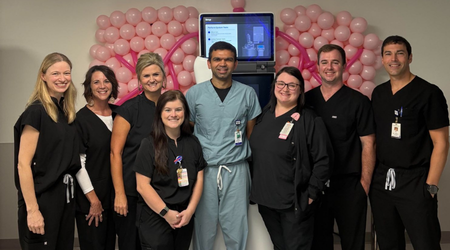
OLOL has transformed lung cancer care across their health system, even lowering the tracked nodule threshold to unlock more opportunities for early intervention. They now have a scalable model for early detection – resulting in measurable stage shift (70% cancer detected in early stages) and procedural growth (2x Ion bronchoscopies and thoracic oncology surgeries).
The volume and stage shift we’ve seen is way beyond what I thought was possible here in Southern Louisiana.Dr. Emily Cassidy, Thoracic Surgeon